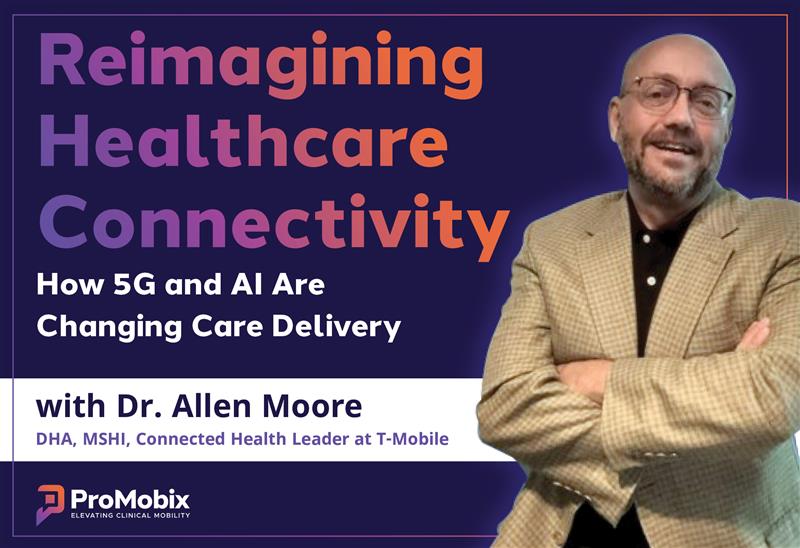
Healthcare is no longer confined to the four walls of a hospital. From real-time clinical collaboration to remote patient monitoring, connectivity has become the backbone of modern care. As 5G technology and AI converge, we are entering an era where speed, security, and seamless integration are no longer optional; they are essential for improving outcomes and reducing clinician burnout.
Few leaders understand this transformation better than Dr. Allen Moore, DHA, MSHI, Connected Health Leader at T-Mobile. With over 15 years of experience driving digital innovation in healthcare, he brings expertise in cloud infrastructure, data analytics, and AI-driven solutions, helping organizations modernize care delivery and improve outcomes
“Wouldn’t it be great if the patient could do X? Wouldn’t it be fantastic if the social worker had access to Y? Wouldn’t it be great if the physician could go from the basement to the seventh floor without having to log in again?” said Dr. Moore. He challenges healthcare leaders to think differently about connectivity—not just as infrastructure, but as an enabler of better outcomes and simpler workflows.

One Size Does NOT Fit All
Healthcare leaders often assume that carrier constraints limit devices and networks, leading to rigid workflows where applications are tied to specific hardware, and connectivity is treated as a separate layer. Dr. Moore argues these limitations stem from outdated thinking, not the technology itself. By blurring the lines between applications and connectivity, organizations can unlock new possibilities for care delivery inside and outside hospital walls. This shift doesn’t require reinventing the wheel, just adopting a mindset that views technology as adaptable and integrated rather than fixed and siloed.
“We assume that this device is doing all it can do and it’s not… We’ve been trained for the past 40 years to use a device as the carriers instructed us to use the device… We continue to think about the application and the connectivity space separately,” said Dr. Moore. “If you start to blur those lines… it takes a new mindset.”

The Power of 5G and Micro Slicing
Micro-slicing is a powerful feature of 5G technology that allows networks to allocate dedicated “slices” for specific applications or use cases. As the fifth generation of wireless connectivity, 5G is designed to deliver faster speeds, lower latency, and greater network capacity than previous cellular technologies. Instead of treating all traffic equally, micro-slicing prioritizes critical functions, such as real-time video, voice transcription, or clinical data transfer, by delivering low latency, minimal jitter, and optimized bandwidth. This tailored approach ensures that healthcare applications perform reliably, even in high-demand environments, enabling better outcomes and a smoother experience for clinicians and patients alike.
Micro-slicing isn’t just a theoretical concept; it is already proving its value in high-performance environments. Dr. Moore points to recent use cases in Formula One and PGA events, where dedicated network slices ensured flawless video transmission by optimizing packet sizes and prioritizing photojournalism traffic. This same principle is now being applied in healthcare to address real-world challenges, such as improving clinical transcription accuracy.
By delivering ultra-low latency and stable connectivity, micro-slicing ensures critical healthcare applications. From transcription to remote monitoring, performed flawlessly. This reliability reduces errors, speeds up decision-making, and drives better patient outcomes. When technology works seamlessly, clinicians can focus on care instead of troubleshooting.
Securing Healthcare in the Age of AI Threats
Cybersecurity has become one of the most pressing challenges in healthcare, especially as AI-driven attacks grow more sophisticated. Traditional security models often rely on VPN tunnels, which add overhead and slow down performance. Dr. Moore explains that 5G standalone (SA) networks change the game by offering inherent security that rivals, and in some cases exceeds, that of wired connections. Unlike older LTE standards, which haven’t been updated in over a decade, 5G SA is built on contemporary security protocols that protect sensitive patient data without sacrificing speed or efficiency. This means healthcare organizations can deliver traffic faster, reduce vulnerabilities, and maintain compliance—all without the burden of outdated security layers.
As cyber threats escalate, healthcare organizations must rethink their security approach. “It’s not a question of if, it’s a question of when, right? So you want to mitigate as much as you can,” said Dr. Moore. Traditional VPN tunnels add complexity and slow performance, but 5G standalone networks eliminate that burden by providing inherent security that is as strong or stronger than that of wired connections. This modern architecture allows traffic to move faster without sacrificing protection, giving hospitals a critical advantage against increasingly sophisticated attacks.
The cost of inadequate security is not theoretical—it’s real and expensive. Dr. Moore shared an example where a healthcare organization faced a $198,000 penalty after a clinical health worker misplaced a tablet containing sensitive data. Incidents like this underscore why security cannot be treated as an afterthought. With 5G standalone networks offering stronger inherent protections than outdated LTE standards, healthcare organizations have an opportunity to reduce risk dramatically. As Dr. Moore emphasizes, security isn’t optional; it’s foundational to safeguard patient trust and ensuring compliance in an era of rising cyber threats.

Advice for Healthcare Leaders
Healthcare leaders don’t need to jump straight into full-scale deployments to innovate; they can start by testing new technologies in safe, controlled environments. Dr. Moore encourages leaders to ask bold questions, such as, “I wonder if we did X, would that have a change in the outcome?” Instead of taking risks on unproven solutions, he recommends using clinical labs and review boards to confirm bedside technology before rolling it out widely. This approach not only minimizes risk but also builds confidence in the results.
Interoperability and evidence-based adoption are just as important. “Let’s put this through the rigor of some research and actually prove, this is evidence-based medicine, just like you would find in pharmacy—that we know because we’ve measured this at bedside in a controlled environment, this will help us dial in a 33-degree change for improved outcomes,” said Dr. Moore. By focusing on solutions that integrate seamlessly and backing decisions with real data, organizations can ensure that innovation truly improves care rather than adding complexity.
Dr. Allen Moore, DHA, MSHI, is a Connected Health Leader at T-Mobile and a recognized expert in healthcare technology and innovation. With over 15 years of experience driving digital transformation, he specializes in leveraging 5G, AI, and advanced connectivity solutions to improve clinical workflows and patient outcomes. His ability spans cloud infrastructure, data analytics, intelligent automation, and emerging technologies, enabling him to guide health systems through modernization and interoperability challenges. Known for his visionary approach, Dr. Moore partners with healthcare leaders to reimagine care delivery, breaking traditional constraints, enhancing cybersecurity, and enabling innovations like micro-slicing for real-time collaboration and remote patient monitoring.